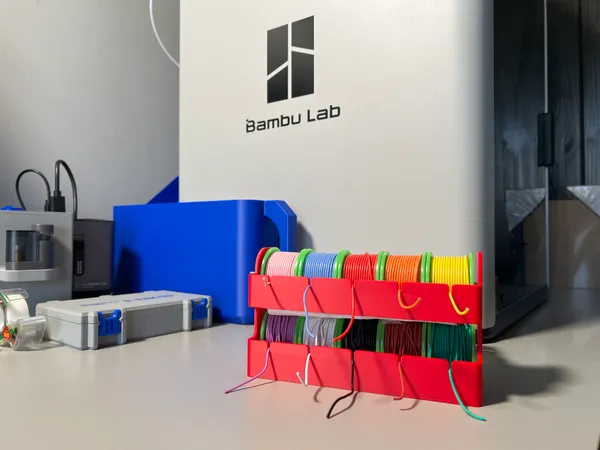
Wire Spool Rack
Built
A 10-spool rack generated from the spool measurements, and a hex bore that took two test prints to get right.
Parts defined as code — parametric, diffable, and regenerated rather than redrawn.
I mostly don’t draw parts. I write the program that generates them.
The models I produce are parametric Python — CadQuery or manifold3d — emitting STEP for CAD work and STL or 3MF for printing. Change the stock thickness at the top of the file, re-run it, and every dependent dimension follows: leg lengths, hole positions, the cut list. Nothing is left behind holding an old number.
That sounds like a detail. In practice it changes what a revision costs. A drawn design has to be re-drawn; a written one gets edited and re-run. The source is text, so changes are diffable and the reasoning sits in comments next to the dimension it explains — which means that six months later, “why is this wall 3 mm?” has an answer instead of a shrug. Twenty-five years of treating source as something that has to be maintained turns out to transfer directly.
The clearance between two parts is the thing most likely to be wrong and the hardest to reason your way to. So I don’t.
I sweep it instead. Generate the candidates as a ladder — a series of test pieces a few tenths of a millimetre apart, each marked so you can tell them apart afterwards — make them all at once, and find out physically which one is right. The measured number then goes back into the source as a parameter, and every part depending on it updates.
One test print replaces an assumption with a measurement. On anything that has to fit, that’s the cheapest hour in the project.
The production method belongs in the geometry from the start, not as a correction afterwards.
Overhangs become self-supporting angles, so a print needs no supports and no clean-up. A welded frame gets butt joints rather than mitres, so every cut is square and errors don’t accumulate across the assembly. Material is chosen for the load case rather than for familiarity — PETG rather than PLA where a part sits under constant load, because PLA creeps.
None of that is visible in the finished object. The point of it is a build that goes together without surprises.
Good design work mostly shows up later, as the absence of problems. That makes it easy to undervalue and expensive to skip.
Built
A 10-spool rack generated from the spool measurements, and a hex bore that took two test prints to get right.
Tell me about the problem and I'll tell you honestly whether I can help.